Blog Posts
- Star Wars Great Hyperspace War
- Arctic Cat 660 Turbo
- Svu Black Ops 2
- Ekor Harimau Sejati Mp3 Free Download
- Free Games To Download Stories
- Excel Power Query Benefits
- La Visita Del Vicio Jose Ramon Larraz, 1978.
- Hot Wheel Games Download
- Resident Evil Code Veronica X Gamecube Iso
- God Of War Hacked More Hacked Games
- Comisarul Rex Sezonul 1 Episodul 1 Subtitrat In Romana
- Get Free Sib Icon Editor Registation Code
- Download Show The Strokes Torrent
- Asuka Kenzan Windows Iso
- Bring Me The Horizon Pirates Of The Caribbean
- Vsphere Data Protection 6.0
- Version Build 3200 License
- How To Move Sims Out Sims 4
- World Execute Me Lyrics
- Minecraft Final Fantasy Texture Packs
- Where Are Restore Points Saved
Anarchic Orders And Balances Of Power, By Kenneth N. Waltz
30.09.2019by admin
Anarchic Orders And Balances Of Power, By Kenneth N. Waltz 3,9/5 1478 reviews
- Anarchic Orders And Balances Of Power By Kenneth N. Waltz Youtube
- Anarchic Orders And Balances Of Power By Kenneth N. Waltz Full
- Anarchic Orders And Balances Of Power By Kenneth N. Waltz Sheet Music
Summary, Kenneth Waltz, Chapter 5 in Keohane “Anarchic Orders and Balances of Power” Waltz begins his analysis with the commonly quoted phrase that among states, the state of nature is equivalent to the threat of war and that this arises from the fact that states are ordered anarchically.
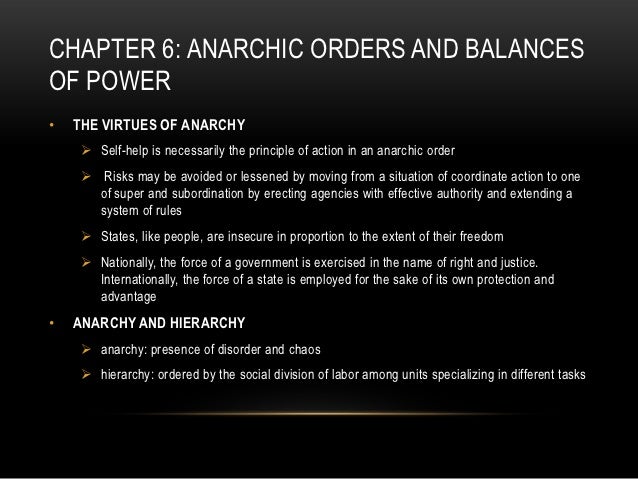
Author by: Kenneth N. WaltzLanguange: enPublisher by: Waveland PressFormat Available: PDF, ePub, MobiTotal Read: 19Total Download: 819File Size: 44,6 MbDescription: From Theory of International Politics. National politics is the realm of authority, of administration, and of law. International politics is the realm of power, of struggle, and of accommodation. States, like people, are insecure in proportion to the extent of their freedom.
If freedom is wanted, insecurity must be accepted. Organizations that establish relations of authority and control may increase security as they decrease freedom.
If might does not make right, whether among people or states, then some institution or agency has intervened to lift them out of natures realm. The more influential the agency, the stronger the desire to control it becomes. In contrast, units in an anarchic order act for their own sakes and not for the sake of preserving an organization and furthering their fortunes within it. Force is used for ones own interest. In the absence of organization, people or states are free to leave one another alone. Even when they do not do so, they are better able, in the absence of the politics of the organization, to concentrate on the politics of the problem and to aim for a minimum agreement that will permit their separate existence rather than a maximum agreement for the sake of maintaining unity. If might decides, then bloody struggles over right can more easily be avoided.
Author by: Kenneth Neal WaltzLanguange: enPublisher by: Waveland PressIncFormat Available: PDF, ePub, MobiTotal Read: 89Total Download: 325File Size: 42,5 MbDescription: Table of Contents - 1. Laws and Theories; 2. Reductionist Theories; 3. Systemic Approaches and Theories; 4.
Anarchic Orders And Balances Of Power By Kenneth N. Waltz Youtube
Reductionist and Systemic Theories; 5. Political Structures; 6. Anarchic Orders and Balances of Power; 7. Structural Causes and Economic Effects; 8. Structural Causes and Military Effects; 9.
The Management of International Affairs. Author by: R. Harrison WagnerLanguange: enPublisher by: University of Michigan PressFormat Available: PDF, ePub, MobiTotal Read: 75Total Download: 925File Size: 42,7 MbDescription: Dismantles the fundamental workings of Realism and exposes its intrinsic flaws.
This book demonstrates that any understanding of international politics must be part of the more general study of the relationship between political order and organized violence - as it was in the intellectual tradition from which modern-day Realism was derived. Author by: R.
LieshoutLanguange: enPublisher by: Edward Elgar PublishingFormat Available: PDF, ePub, MobiTotal Read: 13Total Download: 658File Size: 50,6 MbDescription: 'When the epistemology is sound, intelligence and hard work are sure to bring progress, as they have in this ambitious book by Robert Lieshout. Even some people, like me, who are not specialists in international relations, will find it useful.' - Mancur Olson, formerly of University of Maryland, US Between Anarchy and Hierarchy offers a stimulating new perspective on conflict and collaboration in international politics. Robert Lieshout's new book shows how decision-making within individual states influences foreign policy and, in turn, international politics.
Using a sliding scale between anarchy and hierarchy, he shows how each political system can be defined, including the distinctly anarchic international system itself. By showing the impact which internal decision-making processes have on the structure of the international system, Professor Lieshout integrates a theory of foreign policy making into a theory of international politics. Author by: Daniel W.
DreznerLanguange: enPublisher by: Princeton University PressFormat Available: PDF, ePub, MobiTotal Read: 9Total Download: 135File Size: 50,7 MbDescription: What would happen to international politics if the dead rose from the grave and started to eat the living? Daniel Drezner's groundbreaking book answers the question that other international relations scholars have been too scared to ask. Addressing timely issues with analytical bite, Drezner looks at how well-known theories from international relations might be applied to a war with zombies. Exploring the plots of popular zombie films, songs, and books, Theories of International Politics and Zombies predicts realistic scenarios for the political stage in the face of a zombie threat and considers how valid—or how rotten—such scenarios might be. This newly revived edition includes substantial updates throughout as well as a new epilogue assessing the role of the zombie analogy in the public sphere.
Author by: Stephanie LawsonLanguange: enPublisher by: John Wiley & SonsFormat Available: PDF, ePub, MobiTotal Read: 79Total Download: 778File Size: 46,9 MbDescription: Since the field of International Relations was established almost a century ago, many different theoretical approaches have been developed, each offering distinctive accounts of the world, why it has come to be the way it is, and how it might be made a better place. In this illuminating textbook, leading IR scholar, Stephanie Lawson, examines each of these theories in turn, from political realism in its various forms to liberalism, Marxism, critical theory and more recent contributions from social theory, feminism, postcolonialism and green theory. Taking as her focus the major practical issues facing scholars of international relations today, Lawson ably shows how each theory relates to situations?on the ground?
Each chapter features case studies, questions for discussion to encourage reflection and classroom debate, guides to further reading and web resources. The study of IR is a profoundly normative enterprise, and each theoretical school has its strengths and weaknesses. Theories of International Relations encourages a critical, reflective approach to the study of IR theory, while emphasising the many important and interesting things it has to teach us about the complexities and challenges of international politics today.
Author by: Charles L. GlaserLanguange: enPublisher by: Princeton University PressFormat Available: PDF, ePub, MobiTotal Read: 29Total Download: 403File Size: 42,8 MbDescription: Within the realist school of international relations, a prevailing view holds that the anarchic structure of the international system invariably forces the great powers to seek security at one another's expense, dooming even peaceful nations to an unrelenting struggle for power and dominance. Rational Theory of International Politics offers a more nuanced alternative to this view, one that provides answers to the most fundamental and pressing questions of international relations. Why do states sometimes compete and wage war while at other times they cooperate and pursue peace? Does competition reflect pressures generated by the anarchic international system or rather states' own expansionist goals? Are the United States and China on a collision course to war, or is continued coexistence possible? Is peace in the Middle East even feasible?
Charles Glaser puts forward a major new theory of international politics that identifies three kinds of variables that influence a state's strategy: the state's motives, specifically whether it is motivated by security concerns or 'greed'; material variables, which determine its military capabilities; and information variables, most importantly what the state knows about its adversary's motives. Rational Theory of International Politics demonstrates that variation in motives can be key to the choice of strategy; that the international environment sometimes favors cooperation over competition; and that information variables can be as important as material variables in determining the strategy a state should choose.

Summary, Kenneth Waltz, Chapter 5 in Keohane “Anarchic Orders and Balances of Power” Waltz begins his analysis with the commonly quoted phrase that among states, the state of nature is equivalent to the threat of war and that this arises from the fact that states are ordered anarchically. Waltz contends that the very fact of the absence of government does not automatically imply greater violence – in fact, some of the most destructive wars of history took place within and not between, states.
Anarchic Orders And Balances Of Power By Kenneth N. Waltz Full
He uses this fact to maintain that “no human order is proof against violence,” (99) and that the “distinction between national and international realms of politics is not found in the use or nonuse of force but in their different structures.” (99) The primary difference in structure that Waltz points to is that the international system is one of self-help, whereas the domestic system is not. This means that states cannot afford to specialize and increase their level of economic interdependence in the way parts of a nation can. Because they can rely on no one to protect them internationally, they have to expend part of their effort in “providing the means of protecting themselves against others.” (101). Waltz frequently draws a parallel between competition and cooperation in the economic market and in the area of international politics. Like individual firms, states would like to increase their gains, but even if cooperation with another state would bring about large gains, they will not do so if they fear these gains will be distributed unequally – if it will change the relative distribution of power. States also worry that they will become dependent on others through cooperative endeavors and exchanges. Waltz contends that the very nature of this structure causes international consequences which states as actors don’t necessarily intend.
Here again, he uses an economic analogy. You expect a run on a bank. If you go quickly and get your money out, you have a good chance of recouping your money. If everyone does this, the bank will not remain solvent. But pursuit of individual interest compels you to take a course which will produce a collectively bad outcome – by not running, you would be risking losing all of your money. Waltz contends that rational behavior in the international system “given structural constraints, does not lead to the wanted results.
Anarchic Orders And Balances Of Power By Kenneth N. Waltz Sheet Music
With each country constrained to take care of itself, no one can take care of the system. Without a structural change, things like the arms race, population growth, and pollution will continue to be problematic side effects of states’ pursuit of self-interest. But Waltz doesn’t want a structural change. Instead, he points to the “virtues of anarchy.” Any governing organization seeks to maintain its own existence as an organization, and Waltz thinks that because any central governing agency would be subject to so much controversy over who controls it and what policies it should implement, it would never attain the strong power it would need to control member states.
In the absence of such an organization, Waltz maintains that “states are free to leave each other alone.If might decides, then bloody struggles over right can be avoided.” (110). Finally, he answers criticisms that maybe a more modified version of the anarchic system would be possible. Waltz asserts that there are only two ordering principles of political systems: anarchy and hierarchy.
Every system tends toward one or the other in greater or lesser degree and they can therefore be classified. Structurally, the question becomes one of what better approximates the system; that principle can then help explain its behavior. Waltz sees a regular pattern of behavior in the international system that can be described a Realpolitk. “The state’s interest provides the spring of action; the necessities of policy arise from the unregulated competition of states; calculation based on these necessities can discover the policies that will best serve a state’s interest; success is the ultimate test of policy; and success is defined as strengthening and preserving the state.” (116). Balance-of-power (BOP) theory is what explains the results of states’ individual pursuit of Realpolitik policies. BOP theory assumes that states, “at a minimum, seek their own preservation and, at a maximum, drive for universal domination.” (117).
They can do this by means of internal efforts (increasing economic power, military strength, etc.) and external efforts (strengthening one’s own alliance/weakening an opposing one). BOP theory does not imply that states act with the intention of preserving the balance. They may or may not have this intention. It simply means that the BOP is what results from all states acting rationally out of self-interest. “BOP politics prevail wherever two, and only two requirements are met: that the order be anarchic and that it be populated by units wishing to survive.” (120). To those who contend that BOP theory does not explain states’ policies, Waltz responds that the theory is not a theory of foreign policy, but of international politics: it cannot describe who a particular state will behave in a particular situation, but instead it explains the outcome of collective behavior.Finally, Waltz seeks to test his theory. He maintains that one should not apply only falsification as the ultimate test but that one should seek out confirming examples as well.
The problem is that a) BOP theory offers indeterminate predictions and b) although states’ actions are shaped by external conditions, they are subject to internal considerations as well. He looks for instances of states’ allying even though they have good reasons not to (France and Russia in 1894). He contends that states in competition tend toward sameness in policy and towards socialization to international norms.
This he sees as indicating an acceptance of the rules of power politics.