Blog Posts
- Download Power Geez For Windows
- Get Famous Sims 4
- Hrd Last Free Version Download
- Albert Camus Stranac Pdf
- Windows Nt 6.1 Free Download
- Divinity 2 Source Points
- Sudden Strike 1 Download Full Version
- Share Host Internet Virtualbox
- Parvato Se Aaj Mein Takra Gaya Mp3
- Download Ost Fight For My Way Full
- Dying Light Download Completo
- Memindahkan File Nox App
- Shutter Local Multiplayer Ps2
- Hdd 2,5 Zoll 2tb
- The King Of Fighters Xiv Pc Download
- Astro Vision Lifesign Horoscope Tamil Crack
- Download Need For Speed Carbon For Pc
- Skyrim Horse Vag Mod
- Gta 4 Pc Game Download Highly Compressed
- Serial Win 10 Pro
- How To Install Far Mod Nier
- Dwonlod Dr Jin Drakor Sub Indonesia
- Terra Rossa Epigoni (1992 Mp3 Download
Urdu Grammar Masculine Feminine
26.08.2019by admin
Urdu Grammar Masculine Feminine 4,1/5 6955 reviews
Pama–Nyungan languages including Dyirbal and other Australian languages have gender systems such as: Masculine, feminine (see Women, Fire, and Dangerous Things), vegetable and neuter. (Some linguists do not regard the noun class system of this language as grammatical gender.). If you're trying to learn Urdu, check our courses below about adjectives, adverbs, articles, gender (feminine, masculine.), negation, nouns, numbers, phrases, plural, prepositions, pronouns, questions, verbs, vocabulary, excercises.to help you with your Urdu grammar.Below are our free Urdu lessons. Enjoy our courses!
In Urdu there are only two genders: masculine and feminine. It is very difficult for a new user to differentiate between the two genders easily. There are some tricks to find out about themMasculine Nouns:Nouns ending in aa are normally masculine. دادا /Dadaa: Grandfather.
ابا/Abaa: Father. بکرا /Bakraa: Male GoatFeminine Nouns:Nouns ending in ii are normally feminine. دادی/dadii: grandmother. بچی /bachii: girlThere may be some exceptions to these rules. For e.g friend or dost could be a girlfriend or boyfriend although the other part of the sentence may disclose the gender.It is also possible to make a noun out of a verb. All verbs are normally masculine where used as infinitives. Some endings may be used to derive a noun from them1.
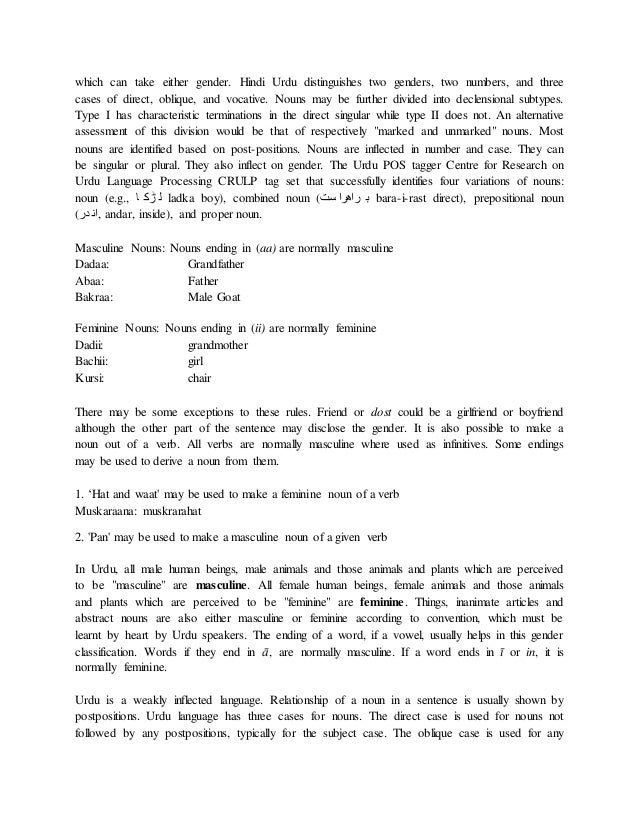
Ii, n, hat and waat' may be used to make a feminine noun of a verb. مسکرانہ/muskaraana: muskrarahat2. Oo, 'pan', may be used to make a masculine noun of a given verb. Contents.Explanation In Urdu, there are only two genders. All male human beings and male animals (or those animals and plants which are perceived to be 'masculine') are masculine. All female human beings and female animals (or those animals and plants which are perceived to be 'feminine') are feminine.
Things, inanimate articles and abstract nouns are also either masculine or feminine according to convention, which must be learnt by heart by Urdu speakers. The ending of a word, if a vowel, usually helps in this gender classification. Words if they end in ā, are normally masculine. If a word ends in ī or in, it is normally feminine.Urdu is a weakly inflected language; the relationship of a noun in a sentence is usually shown by (i.e., prepositions that follow the noun).
Urdu language has three cases for nouns. The is used for nouns not followed by any postpositions, typically for the subject case. The is used for any noun that is followed by a postposition. Some nouns have a separate. Urdu has two numbers: singular and plural — but they may not be shown distinctly in all declinations.
Zephyr theme 5 4 download tutorials. But remember you should never use it for commercial purpose, You just can use it for testing.
Note that some people nasalize the case ending of the vocative plural case too. The following patterns are perceived from Tiwari (1966 2004).1. Masculine nouns ending in ā This category includes masculine nouns ending in ā,لڑکا / larkā — a boyDeclined formCase suffixSingularPluralSingularPluralDirectلڑکا / larkāلڑکے / larke-eObliqueلڑکے / larkeلڑکوں / larkoⁿeoⁿVocativeلڑکے / larkeلڑکو / larkoeo3.
The adjective corresponds to the gender of the noun.yaad (f) merii yaad (my memory).Does n't matter about the gender of the speaker.kuttaa (m) meraa kuttaa (my dog)kahaanii (f) lambii kahaanii ( a long story)dost is an interesting example.dost is typically masculine and culturally/linguistically speaking a man/boy's male friend is a dost/mitr and a woman/girl's female friend is a sahelii. But, in these modern times, the language has changed to accommodate new sensitivities.meraa dost = my male friendmerii dost = my female friendIn both cases 'my' can be a male speaker or a female speaker. You are most welcome. QP SaaHib, in Urdu (and Colloquial Hindi) for the nominative case: merii / tumahaarii (terii) etc.
In this post, I will show you some easy rules which will help you to detect the masculine and feminine nouns in Hindi. Masculine nouns are called (पुल्लिंग संज्ञा – Pulling Sangya) whereas, the feminine nouns are called (स्त्रीलिंग संज्ञा – Striling Sangya). As you have already guessed it, noun is called (संज्ञा - Sangya).
Sing.) and merii / tumhaarii (terii) dost eN ( f. Plural).As you know when referring to masculine friends alone, then and only then dost is not declined: meraa / tumhaaraa (teraa) etc. Dost (m.plural) and mere / tumhaare (tere) etc. Dost (m.plural). If it is mixed male and female friends then the plural is seen only for the females and that too only for emphasis: mere dost aur (merii) dosteN aaj aa-rahe haiN = my male and female friends are coming today. Otherwise one just uses the non-declined form even when there is mixed male and female company. ^ Faylasoof, I meant to answer my own question when Kahaani replied to me but I forgot all about it.Yes I too had 'dost eN' in mind, Faylasoof SaaHib, and in all honesty I find it rather 'awkward' to say the least, albeit it is perfectly legitimate formation from the grammatical perspective.
Urdu Grammar Masculine Feminine Tattoos
I can't comment about its use in Hindi. My concern is what will happen to be-chaarii 'sahelii' and even more beatiful (to my mind) 'sakhii'. I am of course aware that a male saying 'dosteN' would not have 'saheliyaaN' or 'sakhiyaaN' in mind! I see, thank you a lot!So in the case of words like dost and DaakTar, the plural feminine sufix (in nominative of course) will not be added to the nouns but semantically it still affects adjectives - so sentences like - Meri dost/meri DaakTar aa gayi haiN - would be correct in standard hindi?What about the word saNtaan? Primarily the gender of the word is feminine and it means - offspring, children; descendants (I am guessing its a noun in sg. Which means a group of something, i.e. But it can also mean a son (then its masc.) and/or daughter (then its fem.) - according to Oxford's dictionary.
My question is, when in plural - is the case same as with the words maNgetar? (means, mere santaan (my sons), meri santaaneN (my daughters)). What about meri mitreN? As in - my friends (who are female).
Meri mitreN aa gayi haiN.Is there any actual rule in some grammar book about this? I couldnt find it.
All i can find is that some of the words can denote both male and female - there is nothing about the usage, sufixes and adjectives.Here are some of the words which dictionaries consider as both F and M - daaktar, mantrii, mitr, santaan, mangetar.Words like dost are of M gender in dictionaries.So what I have come to the conclusion might be this - if the word is M or can be both M and F - it will act like M in the declension paradigm but the adjective will get the correct gender. So if we say Meri daaktar aa gayi hain or Meri mitr aa gayi hain.it would be ok right?Now, im thinking about this. Santaan is originally F, and so is for example savaari (passenger). While savaari can be only F and nothing but F, even the passenger is a male person, santaan can mean son (then its M) or daughter (then its F).
Masculine And Feminine Gender List
Would these sentences be correct:Mera saavari aa gaya hai (im guessing this can be only F, even though the passenger might be male right?)Mera santaan aa gaya hai / Mere santaanEN aa gaye hain (what do you say if the meaning is 'son'?)Meri santaaneN aa gayi hain (my daughters have come?). Merii DaakTar aa ga'ii haiNmerii mitra aa ga'ii haiNThese two sentence would be correct if there is only one female doctor and one female friend and one is using a plural verb for respect.meraa savaarii aa gayaa haiThis would be wrong, since 'savaarii' (passenger) is feminine. The correct sentence would be:merii savaarii aa ga'ii hai.even if the passenger is a male person.Similarly,merii santaan aa gayaa hai would be wrong because 'santaan' as far as I know is feminine.
So, if the santaan (progeny) happens to be a male offspring.the correct form would bemerii santaan aa ga'ii hai.mere santaaneN aa ga'e haiN.again is incorrect since santaan is feminine.merii santaan aa ga'ii hai.I know that this is going to be ambiguous but 'santaan' can imply one or more offspring. If there was a situation where a man had children from more than one woman (or a woman with children from more than one man).merii santaan aa ga'ii hai.ormerii santaaneN aa ga'ii haiN.and this does not imply daughters only.
'santaan' is a feminine noun that depicts a son or a daughter. The sentence would merely mean.My offspring are here (males only, females only, a mixture of males and females). After giving this some more thought, the feminine plurals have to be 'merii doste.n' and 'merii mitre.n' in order to be grammatically correct. Otherwise it would be too ambiguous about whether one female friend is meant or more.
But many Hindi speakers just say 'merii friends', 'merii saheliyaa.n', 'merii sakhiyaa.n', or ignore gender rules and say 'mere dost', depending on the situation.Traditionally, 'mitra' and 'dost' have been for male friends only, so dictionaries may not always be up to date. It is only in modern times that they are being used for female friends too.
Masculine Meaning In Urdu
Hence, the confusion about the feminine plural form.YesThe word is 'savaarii'. I don't know if this sentence is correct because I don't use it in this sense. A common word for passenger is 'paise.njar', which is in the masculine form, unless it's a train then it's feminine.CorrectsantaanCorrect. Hi its me again.Which gender do have currencies in hindi - im interested in those who end in -aa, like krona and lira (क्रोना, लीरा). If you have to say 10 kronas/liras/rupees - what would be correct?यह कमीज़ दस रुपये है.यह कमीज़ दस क्रोने है.यह कमीज़ दस लीरे है.Or would lira and krona stay the same?यह कमीज़ दस क्रोना है.यह कमीज़ दस लीरा है.to me it seems there is no reason why these nouns wouldnt change their endings.and there is even the analogy with rupee that can support that.Do they have puling gender or striling?If they are puling, is the noun indeclinable or they behave likenouns like raajaa - they are puling but change only in oblique form in plural.? Hi its me again.Which gender do have currencies in hindi - im interested in those who end in -aa, like krona and lira (क्रोना, लीरा). If you have to say 10 kronas/liras/rupees - what would be correct?यह कमीज़ दस रुपये है.यह कमीज़ दस क्रोने है.यह कमीज़ दस लीरे है.Or would lira and krona stay the same?यह कमीज़ दस क्रोना है.यह कमीज़ दस लीरा है.to me it seems there is no reason why these nouns wouldnt change their endings.and there is even the analogy with rupee that can support that.Do they have puling gender or striling?If they are puling, is the noun indeclinable or they behave likenouns like raajaa - they are puling but change only in oblique form in plural.?